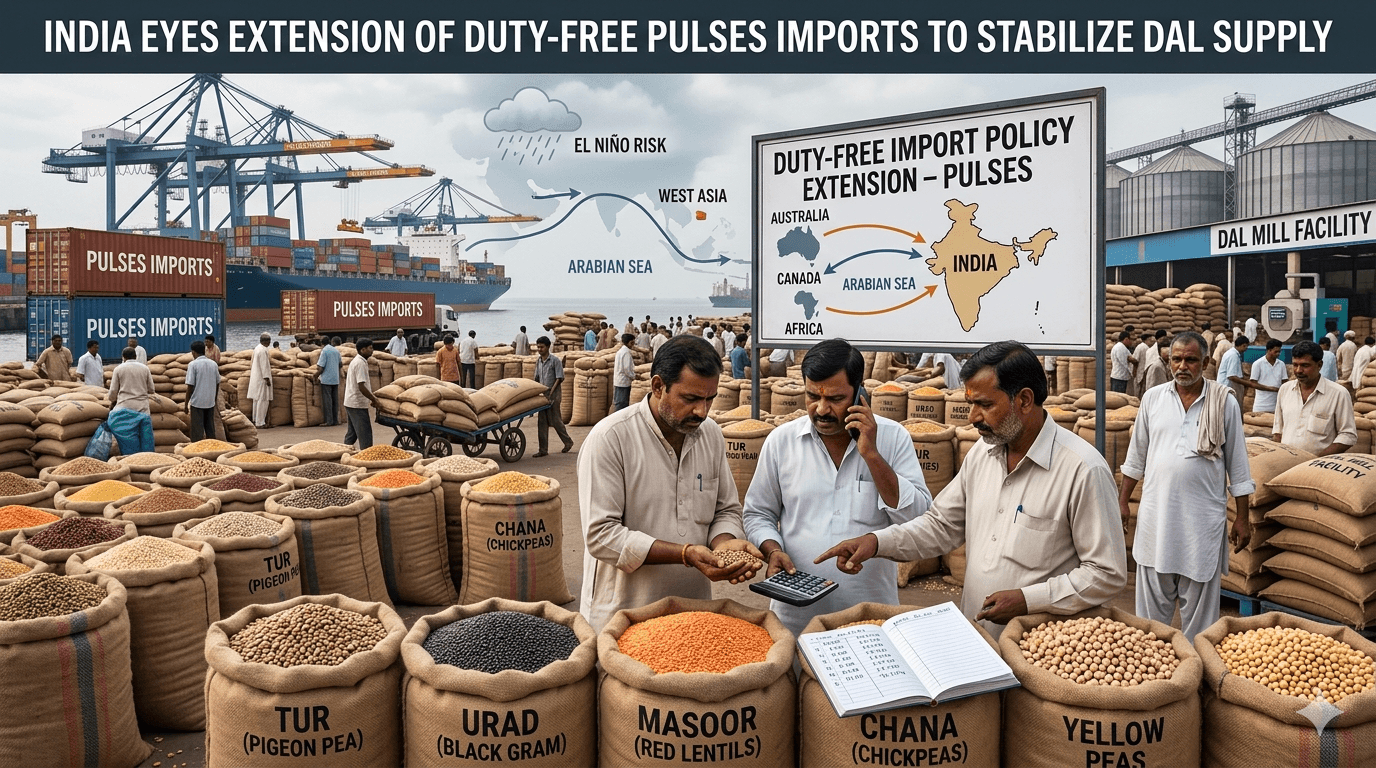
India’s pulses market may see continued duty-free imports beyond March 31, a move that traders are closely watching as global supply risks and weather uncertainties build. For importers, millers, and mandi participants, this policy decision could play a crucial role in maintaining supply flows and preventing sharp price volatility in the domestic dal market. The government is considering the extension as geopolitical tensions in West Asia and the possibility of an El Niño-linked weak monsoon could tighten global and domestic pulses availability.
Policy Extension Could Keep Import Arbitrage Open
If the duty-free import window continues, it will keep import arbitrage opportunities open for traders bringing pulses into India. With zero import duty reducing the landed cost of shipments, overseas sourcing remains attractive for traders supplying dal mills and wholesale mandi markets. As a result, import pipelines for tur, urad, masoor, and chana are likely to remain active, while global suppliers may continue positioning shipments toward the Indian market. For traders, this also means relatively stable trading margins between international prices and domestic mandi rates, allowing them to plan procurement more confidently. Such policy continuity helps the trade manage forward contracts and maintain smoother supply planning across the pulses market.
Global Risk Premium Building in Pulses Trade
Two global factors are adding uncertainty to pulse trade flows.
First, geopolitical tensions around Iran and West Asia could disturb key shipping lanes used for agri commodities moving to India. Any disruption in freight or logistics could push up landed costs. Second, the possibility of El Niño impacting India’s monsoon raises concerns about domestic pulses output. Traders know that even a small production dip can quickly tighten mandi supply. Because of these risks, the government appears inclined to maintain imports as a supply cushion.
What It Means for Dal Markets and Wholesale Trade
For India’s pulses market, an extension of duty-free imports could shape several key trading trends in the coming months. Continued zero-duty imports would likely lead to a stronger arrival of imported pulses, helping balance domestic supply and prevent shortages in wholesale markets. With a steady flow of imports, wholesale dal prices may remain relatively moderate, as consistent availability reduces the risk of sharp price spikes. It would also improve supply visibility for dal millers, stockists, and mandi traders, allowing them to plan procurement and inventory more confidently. In such a scenario, trading activity may remain active in imported varieties such as masoor and yellow peas, which often play an important role in filling domestic supply gaps. Since India consumes significantly more pulses than it produces, global supply channels continue to play a crucial role in maintaining overall market balance.
Market Watch: Pulses Trade Outlook
From a trading perspective, extending the duty-free import window would signal that the government is prioritizing supply stability in the pulses market rather than allowing prices to rise sharply due to tight supply. If the policy continues, traders will closely monitor several market indicators, including global pulses prices, freight and shipping costs, currency movements affecting import parity, and domestic mandi arrivals after the monsoon season. These factors will influence procurement decisions and trading strategies across the dal market. For now, the signal to the trade appears clear imports are likely to remain an important tool for keeping India’s pulses market adequately supplied despite global uncertainties and weather-related risks.